

A customer leaves a review on a Friday afternoon. Your business doesn’t respond until the following Wednesday — if at all. That five-day gap doesn’t just look careless to the reviewer. It’s a signal Google’s local algorithm picks up on when deciding which businesses to surface in local search results.
AI review response tools exist specifically to close that gap. For small businesses without a dedicated marketing team, they’re one of the most practical entry points into AI for local SEO available right now.
Why Review Responses Affect Local Rankings
Review responses do three jobs simultaneously: they reassure the reviewer, they signal trustworthiness to future customers reading the thread, and they tell Google’s algorithm that an active, engaged business is behind the profile. Profiles that respond consistently tend to outperform profiles with the same star rating but zero responses.
The challenge is volume. A single-location service business can easily generate 20 or 30 reviews a month. Writing a thoughtful, non-generic response to every one of them — week after week — isn’t realistic for most owners. That’s the problem these tools solve.
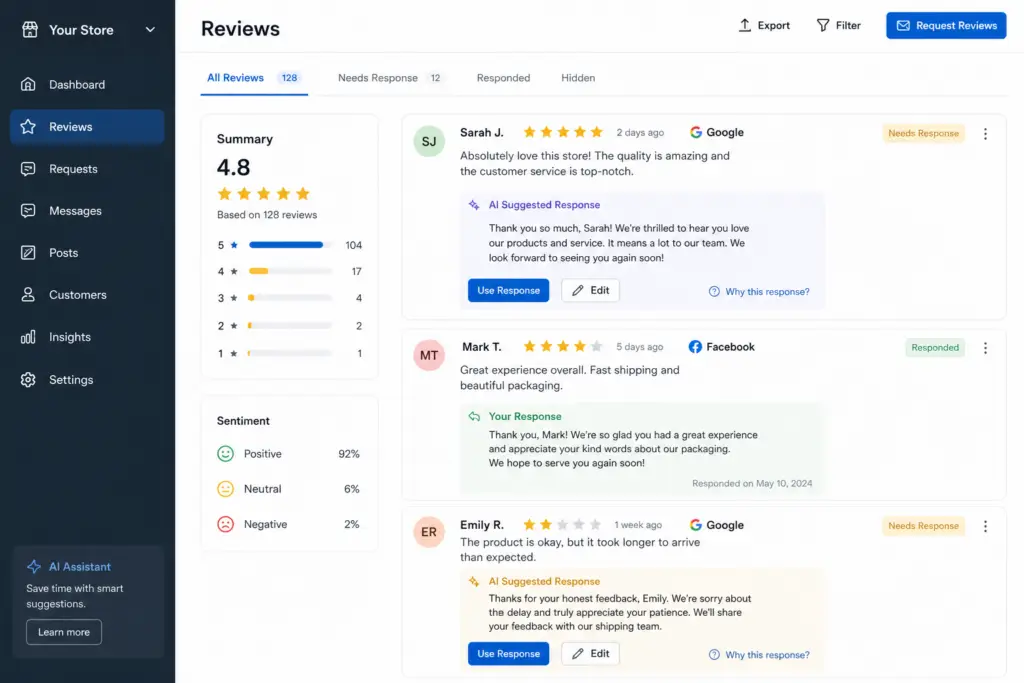
How the Best AI Review Tools Work
The strongest AI review response tools follow a consistent model:
- Pull in new reviews from Google Business Profile (and often Yelp, Facebook, and industry-specific platforms)
- Analyze sentiment — positive, neutral, or negative
- Generate a draft response matched to your brand’s tone
- Auto-publish routine five-star responses and flag negative or complex reviews for human review before anything goes live
That last point matters. Full automation with no human checkpoint is where things go wrong, especially for negative reviews that need a careful, specific response. The best tools are built around this distinction: automate the routine, escalate the exceptions.
Features That Actually Matter
Not all AI review response tools are built equally. The marketing copy tends to obscure real differences. Prioritize these:
- Sentiment-aware drafting. A five-star glowing review and an angry one-star review shouldn’t get the same response template. The tool should know the difference and draft accordingly.
- Brand voice customization. You should be able to configure tone so responses sound like your business, not like obviously generated text.
- Escalation rules. Negative reviews should always route to a real person before publishing — this is non-negotiable.
- Multi-platform coverage. Google isn’t the only place reviews live. The best tools consolidate Google, Yelp, and Facebook into one inbox.
- Response time reporting. You want data on how quickly your team is actually responding, since consistency matters more than any single response.
The Compliance Line
Google doesn’t prohibit AI-assisted review responses. What it prohibits is fake engagement — manufactured reviews, incentivized reviews, or deceptive content. AI tools that help you respond faster to real reviews don’t cross that line.
The risk emerges when automation becomes an excuse to disengage entirely. A response that’s AI-drafted but approved by a real person before publishing is fine. A fully automated pipeline where no one at the business ever reads what goes out is where reputational and policy risk starts to build.
Where This Fits in Your Broader Strategy
Review management is one piece of the puzzle, not a complete strategy. A business with fast, well-written review responses but an incomplete GBP profile or inconsistent listing data is still leaving local visibility on the table.
For a complete look at the tools that handle review automation alongside the rest of GBP management, see our guide to the
7 best AI tools for Google Business Profile optimization
For the listing accuracy side of the equation, see:
AI Business Listing Optimization: Best Practices for 2026
Local SEO Automation Tools: What They Do and Whether Your Business Needs One
If you’d rather have this handled for you entirely, Scalar Advertising’s local SEO services cover reputation management as part of a full strategy — not just a templated response engine.