
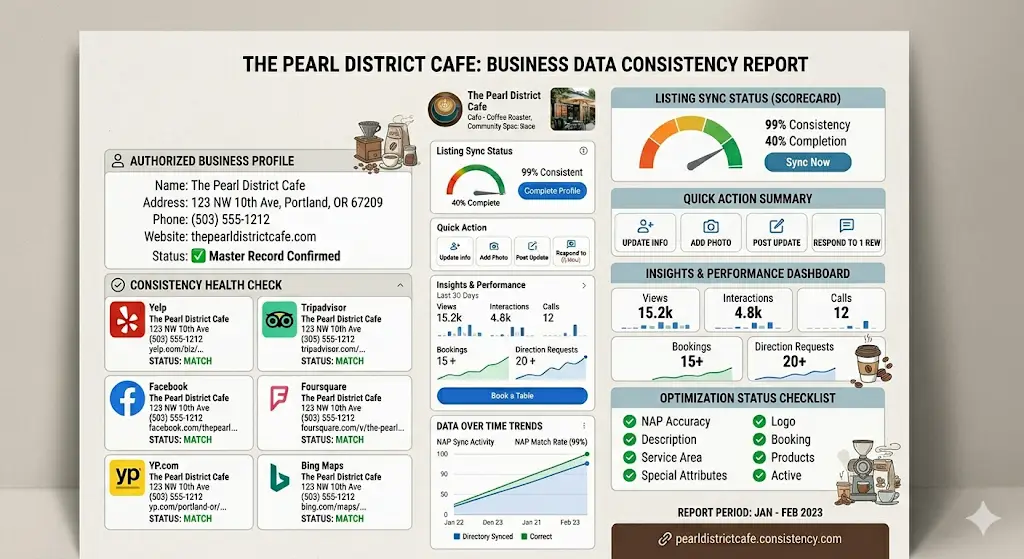
Your Google Business Profile is the most visible listing your business has. But it’s not the only one. Your business information lives across dozens of directories, data aggregators, and mapping platforms — and when that information is inconsistent, it quietly undermines everything else you’re doing in local SEO. AI business listing optimization is the practice of using AI-powered tools to audit, correct, and maintain that information at scale.
Here’s what it means in practice, where the biggest mistakes happen, and what actually moves the needle in 2026.
Why Listing Accuracy Is a Local SEO Foundation Issue
Google cross-references your GBP data against what it finds about your business elsewhere on the web. When your name, address, and phone number are consistent everywhere, that consistency reinforces your legitimacy as a real, established local business. When it’s inconsistent — your address formatted differently on three different platforms, an old phone number still active on a directory you forgot about — it introduces ambiguity that can suppress local rankings.
This isn’t a theory. It’s one of the more documented correlations in local SEO research: businesses with strong citation consistency rank better in the local map pack than businesses with equivalent reviews and similar profile completion but messy listing data.
Where AI Business Listing Optimization Tools Add Real Value
Doing a listing audit manually is painful. There are hundreds of directories where your business might appear — some you’ve intentionally listed on, many you haven’t — and checking them individually isn’t realistic. AI business listing optimization tools automate the audit, flagging discrepancies across platforms and pushing corrections in bulk.
The most useful capabilities tend to be:
- Automated NAP consistency checks. The tool scans directories for your business name, address, and phone number and flags anywhere the data doesn’t match your source of truth. This includes variations you might not think to look for — abbreviations, old suite numbers, outdated area codes.
- Duplicate listing detection and suppression. Duplicate listings are more common than most business owners realize, especially after a move, a name change, or a Google My Business rebrand. Unclaimed duplicates confuse both customers and Google’s algorithm.
- Category and attribute optimization. Your primary business category is one of the most important ranking signals in local search. AI tools compare your current category selection against what’s working for top-ranking competitors in your area and flag gaps.
- Ongoing monitoring. Listings drift over time. Third-party data providers push updates that overwrite your correct information with outdated data. AI monitoring tools alert you when something changes so you can correct it before it compounds.

The Mistakes That Hurt Local Rankings Most
In our experience, the listing issues that cause the most damage are rarely dramatic. They’re boring and invisible until they’re not:
- A suite number included on some listings but not others
- A toll-free number listed on older directories instead of the current local number
- The wrong primary category — usually something too broad — set years ago and never revisited
- Missing hours on GBP (including holiday hours) that send customers to a competitor who’s listed as open
- An unclaimed duplicate profile from a previous address appearing in search results
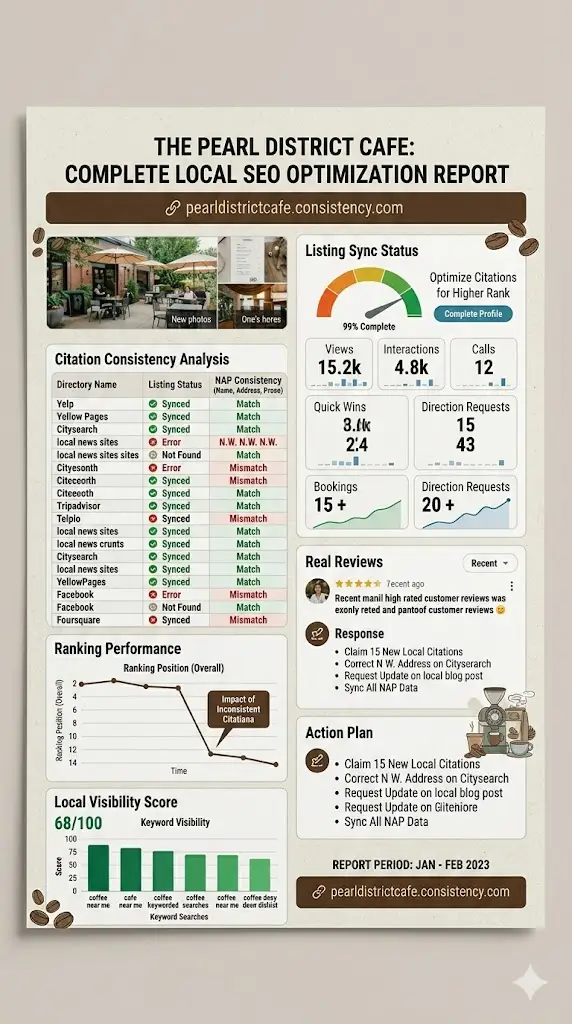
AI business listing optimization tools catch most of these in an initial audit. The value after that is ongoing monitoring so the same issues don’t reappear six months later when a data aggregator pushes a bad update.
How This Connects to the Broader GBP Strategy
Listing accuracy is the floor, not the ceiling. A fully accurate, consistent listing is the baseline your other optimization efforts build on — reviews, posts, photos, and keyword-rich descriptions all carry more weight when the foundational data is clean.
For a complete overview of the AI tools that handle listing optimization alongside the rest of GBP management:
7 Best AI Tools for Google Business Profile Optimization in 2026
Local SEO Automation Tools: What They Do and Whether Your Business Needs One
AI Review Response Tools: How Small Businesses Can Automate Reputation Management
If you’d rather have a team run a full listing audit and handle the corrections for you, Scalar Advertising’s local SEO services are built around exactly this kind of foundational cleanup — followed by the ongoing optimization work that keeps rankings moving in the right direction.