
A homeowner in Orem searches “emergency plumber” on their phone. Three businesses appear on a map with star ratings, hours, and a call button. Most searchers never scroll past them. If your business isn’t one of the three, the rest of your marketing never gets a chance.
Utah local SEO is the work of making your business visible in Google’s location-based results, including the map pack, Google Maps, and local organic listings, for people searching near you. For most small businesses, that comes down to four things: your Google Business Profile, your reviews, a website with pages that match what you sell, and consistent business information across the web.
Most local SEO advice is a flat list of tips, and that’s the problem. A Provo café, a Lehi roofer who works from a home office, and a Park City guide service all need local visibility, but they shouldn’t start in the same place. This guide explains how Google decides who appears, then helps you work out what to fix first based on the kind of business you run.
What Utah Local SEO Actually Covers
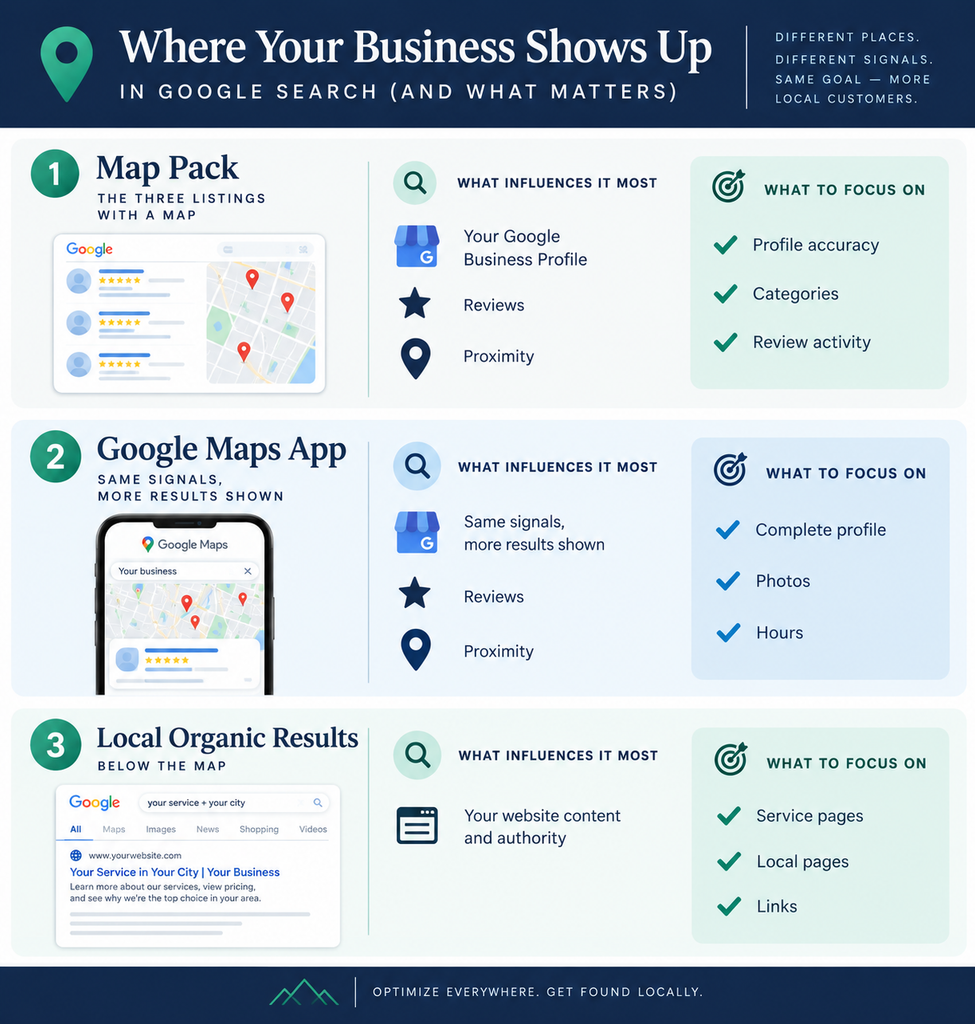
When someone searches for a service near them, Google can show results in three places, and each responds to different work.
This is why owners often say, “My website is fine, but I’m not in the map.” The map and the website are ranked on overlapping but different signals, and neglecting either one costs you calls.
“Near me” searches add another wrinkle. Google decides what “near” means based on the searcher’s location, not yours. You can’t optimize your way into a map pack for a neighborhood you aren’t close to, which brings us to how Google actually decides.
How Google Decides Who Shows Up
- Relevance is how well your profile matches what the person searched for. Your categories, services, and description drive this.
- Distance is how far your business is from the searcher, or from the location named in the search.
- Prominence is how well known and trusted your business appears. Google has said that review count and ratings can influence it, and so can the strength of your website and mentions elsewhere.
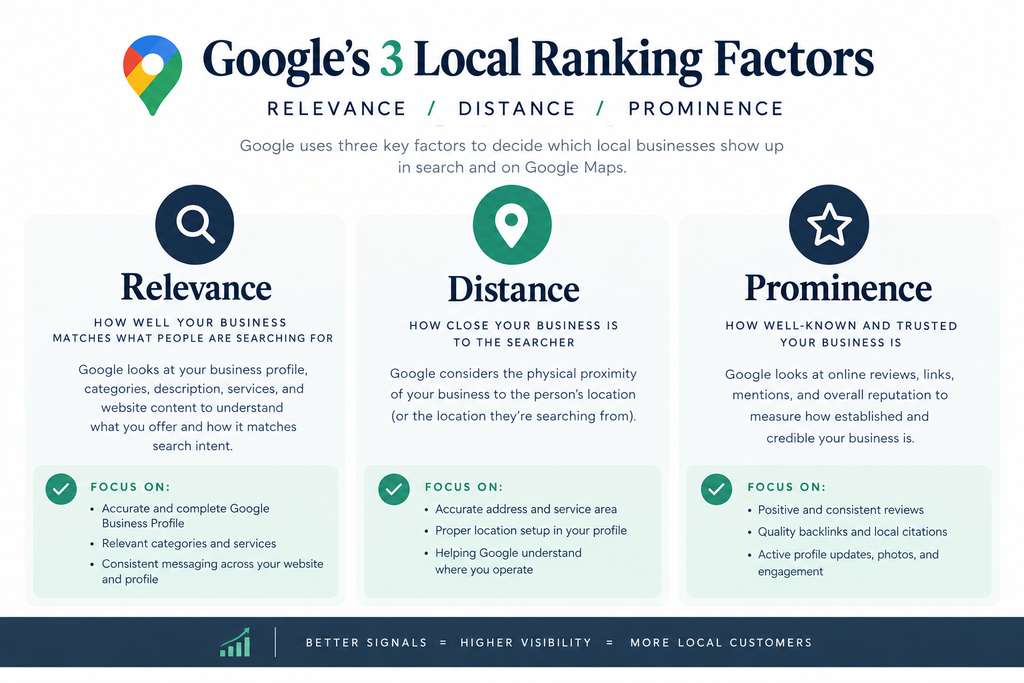
You control relevance and much of prominence. You mostly don’t control distance, and that is where Utah’s geography matters.
Why distance matters more than most owners expect
The Wasatch Front is one continuous stretch of cities. Someone in Lehi can be a short drive from American Fork, Orem, Draper, and Sandy, so a search from one corner of the valley can return a very different set of businesses than a search from another.
A business in St. George will not reliably show up as the closest option to a searcher in Salt Lake City just because it lists Salt Lake City as a service area. Listing an area tells Google where you work. It doesn’t move your physical location.
Why rankings change block to block
Local rankings vary with where the searcher is standing. A business can rank well near its office and poorly a few miles away. That means a single “I searched and we’re #1” check from your own phone tells you very little. We’ll come back to this in the measurement section.
Start With Your Market, Not a Checklist
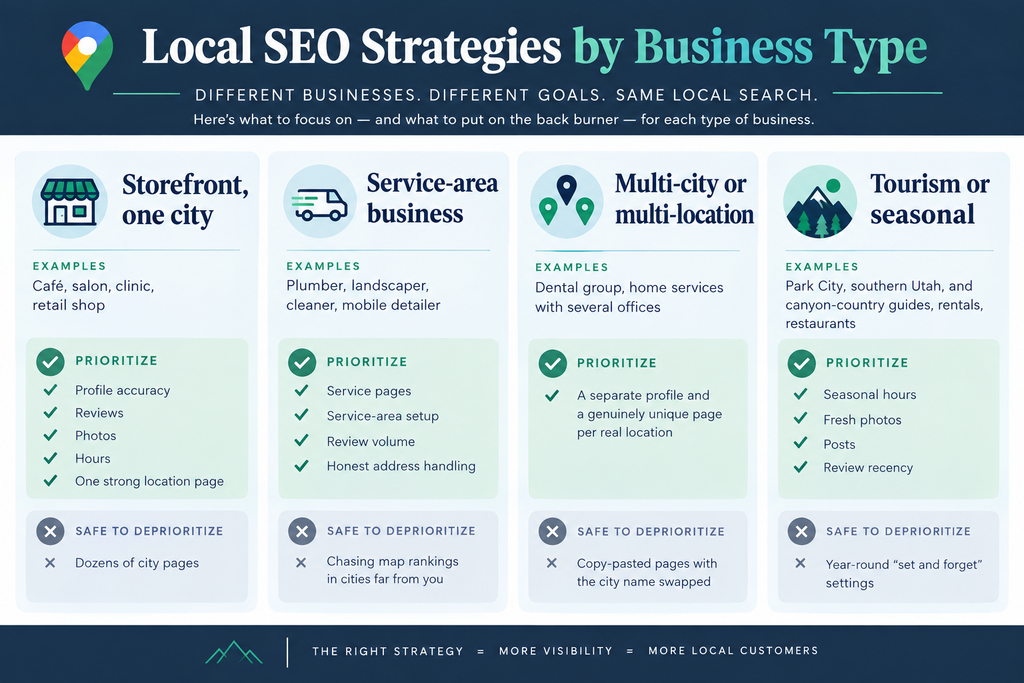
Before touching a single setting, work out which of these four profiles fits you best. Your priorities change depending on the answer.
Competition also varies by city and trade. A roofer in a crowded part of Salt Lake County faces a different fight than a bookkeeper in a smaller town. If you want a broader view of what to fix first across your whole marketing mix, our post on what to fix first when digital marketing isn’t working covers it.
Not Sure What Budget Makes Sense?
Every business has a different customer value and a different competitive landscape. SCALAR Advertising can help you build a Google Ads plan around what a new customer is actually worth to you.
See how SCALAR helps Utah small businesses with paid search →
Fix Your Google Business Profile First
For most small businesses, the Google Business Profile is the highest-leverage, lowest-cost place to start. It’s free, it controls what appears in the map pack, and many owners claimed it years ago and never touched it again.
Categories and services
Your primary category tells Google what you are. Choose the most specific option available. “Roofing contractor” is a stronger signal than a broad category. Add secondary categories only when they describe real services you offer. Then fill out the services list and write a description in plain language: what you do, who you serve, and where.
Service-area businesses and home addresses
Many Utah businesses are run from a home office. Google’s guidelines allow service-area businesses to hide their address if customers don’t visit them there [LINK: Google guidelines for service-area businesses]. Do not use a virtual office, a mail drop, or a friend’s address to appear closer to a city. Doing so risks suspension, and a suspended profile is far more expensive than a lower ranking.
List the cities you actually serve. Be honest about the radius. A tight, believable service area serves you better than a list of thirty cities.
Photos, hours, and posts
Add real photos of your work, team, storefront, and vehicles. Keep hours current, including holidays and seasonal changes. This matters most for tourism and seasonal businesses, where a profile showing winter hours in July costs you real customers. Posts are optional. If you can maintain them, use them for offers and updates. If you can’t, skip them rather than leaving a stale feed.
Next step: Managing all of this by hand is a real time commitment. Our guide to the best AI tools for Google Business Profile optimization covers what can be automated and what shouldn’t be.
Reviews: Earn Them, Ask Them, Answer Them
Reviews do two jobs. They influence prominence, and they persuade the person deciding between you and the next listing.
Competitors with far more reviews are one of the most common frustrations we hear from owners. The honest answer is that there is no magic number. Look at the businesses already showing up for your searches and compare your count, your rating, and how recent your reviews are. Recency matters. A steady flow reads as an active business.
A simple system works better than a one-time push:
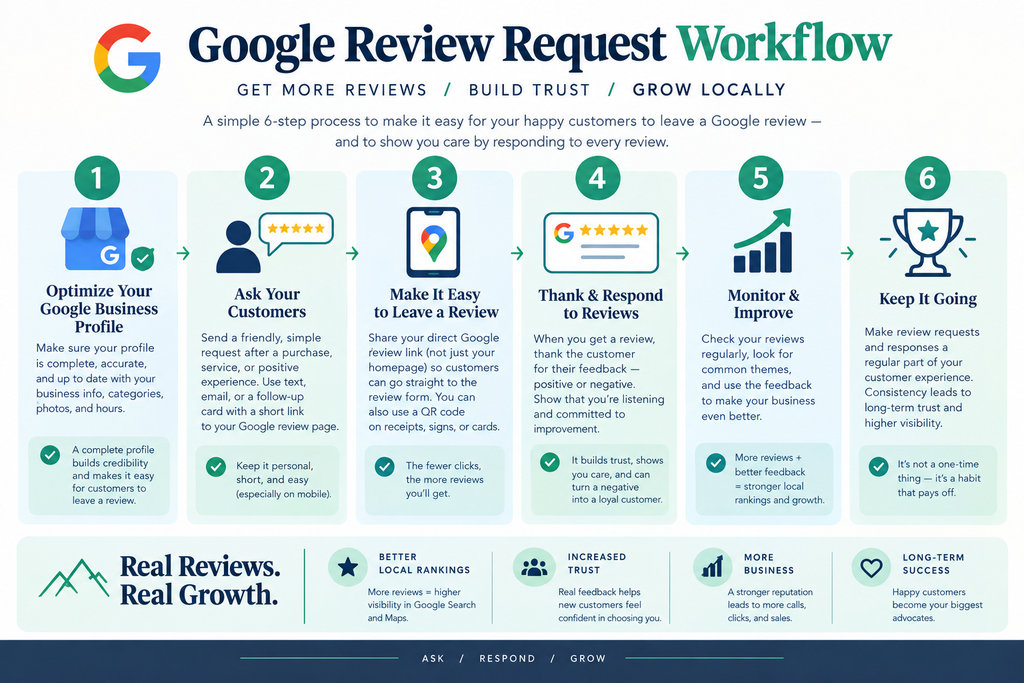
- Ask at the moment of success, right after the job is finished or the customer says thank you.
- Make it easy. Send a direct link to your review form by text or email.
- Respond to every review, positive and negative, in a calm and specific way.
- Stay inside the rules. Don’t buy reviews, don’t offer rewards for them, and don’t screen out unhappy customers before asking. Google’s policies prohibit these practices
[LINK: Google review policy].
If you’re handling dozens of reviews a month, our look at AI review response tools explains where automation helps and where a personal reply still matters.
Make Your Website Support Local Rankings
Your Google Business Profile gets you into the map. Your website helps you rank in the organic results below it, and it’s where the customer decides whether to call.
Build service pages before city pages
Start with one clear page per core service. A page for “drain cleaning” that explains the problem, the process, what it costs to find out, and who does the work will do more than ten thin pages that differ only by city.
Local landing pages: when they help and when they hurt
If you have a real location in a city, or you serve a city with genuinely different needs, a dedicated page can earn its place. Use this test: could this page exist for any other city by swapping the name? If yes, it’s a thin page, and it won’t help you. A useful local page includes:
- Specific details about the area you serve there
- The services you offer in that location
- Real proof, such as photos of local work or reviews from nearby customers
- Local questions answered honestly
- Your name, address, and phone number, matching your profile
Technical basics
Make sure your site loads quickly on a phone, your title tags and headings describe each page clearly, and the site can be crawled. Add LocalBusiness structured data so search engines can read your name, address, phone number, and hours directly. These are table stakes. They won’t win you rankings alone, but a broken foundation can hold back everything else.
If your current site doesn’t have the pages described here, that’s a design question as much as an SEO one. See how SCALAR approaches SEO and website design for Utah businesses.
Keyword Research for Utah Searches
You don’t need expensive tools to start. Begin with how customers actually describe what you do:
- Service plus city: “furnace repair Lehi,” “family dentist Provo”
- Neighborhood or county terms where they apply
- “Near me” phrasing, which Google resolves using the searcher’s location
- Local naming habits. Utahns say Salt Lake, SLC, Utah County, and the Wasatch Front, and your customers may use any of them.
Check Google’s autocomplete suggestions, the search terms shown in your Google Business Profile performance data, and the queries in Google Search Console. Those show real searches that already lead to you. Use what you find in your page titles and headings only where it reads naturally.
Citations and NAP Consistency
A citation is any online mention of your business name, address, and phone number (NAP). Consistency matters because conflicting information makes it harder for Google to trust your details.
Start with the major listings: Apple Business Connect, Bing Places, Yelp, and relevant industry directories. Then check for old information, especially after a move, a rebrand, or a phone number change. Slight differences in suite numbers or business names can create duplicates.
Skip services that promise to submit you to hundreds of directories. A smaller set of accurate, relevant listings is better than a long list of junk. For more on keeping listings clean, see our guide to business listing optimization.
Local Links and Local Content
Links from other local websites are a signal of prominence. Realistic sources for a small business include:
- Your local chamber of commerce
- Community events or sports teams you sponsor
- Suppliers, partners, and neighboring businesses
- Local news or community publications, when you have something worth covering
Local content should answer questions your customers actually have: seasonal preparation, local permit or process questions, or a plain explanation of a common job. Avoid generic “best things to do in [city]” posts that have no connection to your business. They attract the wrong audience.
How to Tell If It’s Working
The number that matters is calls, direction requests, form fills, and booked jobs, not a rank screenshot.
- Google Business Profile performance: calls, direction requests, and website clicks
- Google Search Console: which queries and pages bring people from search
- Google Analytics: whether visitors take the actions you care about
- Call tracking: where phone leads come from, if calls are your main channel
Rank-tracking tools can help, but remember that rankings differ by searcher location. A grid-style local rank tracker is more informative than a single check from your desk.
Timelines vary with competition, your starting point, your trade, and your city. Be wary of anyone who gives you a fixed number of weeks. If you’re evaluating tools that automate tracking and reporting, our overview of local SEO automation tools explains what they do and whether you need one.
Ready to Turn Your Ad Budget Into Real Customers?
Want to turn your advertising budget into measurable growth? SCALAR Advertising helps Utah small businesses build and optimize Google Ads campaigns designed to generate real leads and customers.
Contact SCALAR Advertising about Google Ads management →
Common Utah Local SEO Mistakes
- Copy-pasting one page across five cities. It adds volume and no value.
- Using a fake or virtual address to appear closer to a bigger city.
- Leaving hours stale, especially around holidays and seasonal shifts.
- Ignoring reviews, both asking for them and responding.
- Tracking rank instead of leads.
Your Utah Local SEO Checklist
Work in this order. Each stage builds on the last.
Days 1 to 30: Foundation
- Claim and verify your Google Business Profile
- Choose a precise primary category and add real secondary categories
- Complete services, description, hours, and service area
- Add current, real photos
- Decide which of the four business profiles you are
Days 31 to 60: Trust and consistency
- Set up a simple review request process
- Respond to all existing reviews
- Audit your NAP across major listings and fix mismatches
- Confirm your site loads fast on mobile
Days 61 to 90: Authority and growth
- Build or improve core service pages
- Add location pages only where you can make them genuinely unique
- Earn one or two local links
- Set up Search Console and track calls and direction requests
Common Questions
How do I rank in Google Maps?
Claim and verify your Google Business Profile, choose precise categories, complete your services and hours, collect reviews steadily, keep your listings consistent, and support the profile with a website that has clear pages for each service.
How many Google reviews do I need?
There’s no fixed number. Compare your review count, rating, and recency against the businesses already showing in your map pack, and aim to close the gap with honest, steady requests.
How long does local SEO take?
It depends on competition, your starting point, your trade, and your city. Quick fixes like correcting a profile can show results sooner, while building authority takes longer. Any promise of an exact timeline should be treated with caution.
Can a service-area business rank in cities where it has no office?
It can appear for searches in the areas it serves, but distance still matters. Listing a city as a service area doesn’t make you the closest option to someone searching there.
Do I need a website to appear in Google Maps?
A profile can appear without one, but a strong website supports your local rankings and gives customers somewhere to learn more before they call.
Conclusion
Utah local SEO isn’t a bag of tricks. It’s a short list of fundamentals applied to your market: an accurate profile, genuine reviews, a website that matches how you sell, and consistent information everywhere you’re listed. The businesses that do well don’t do everything. They fix the right things first.
If you’d like a second set of eyes on your local presence, contact SCALAR Advertising for a local SEO review.