
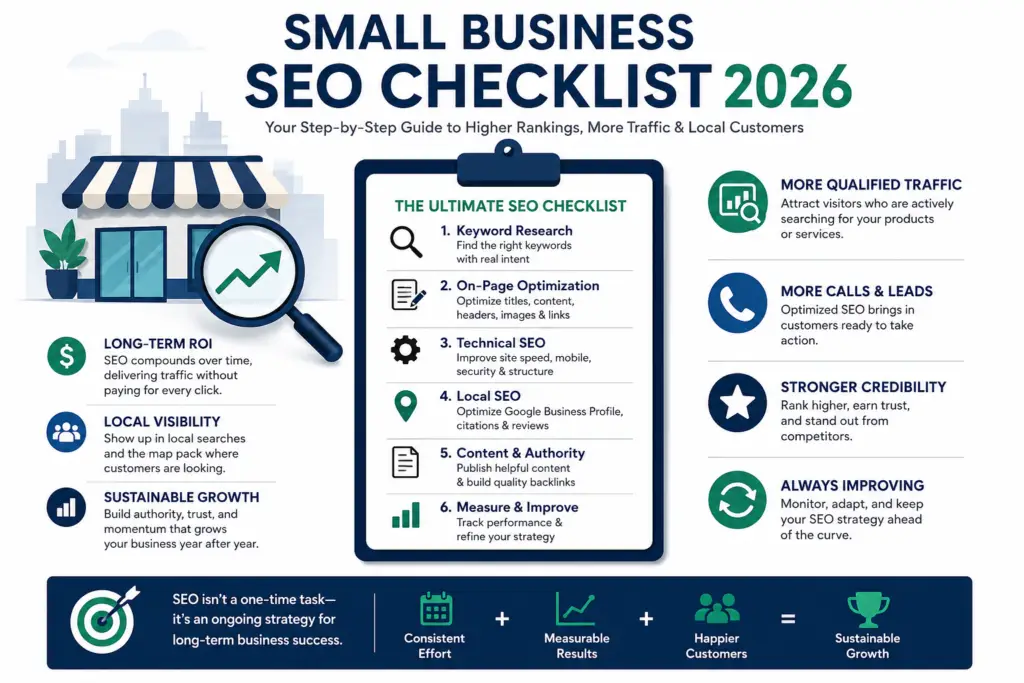
Search behavior keeps shifting, but the fundamentals of SEO haven’t disappeared — they’ve gotten more specific. This small business SEO checklist 2026 breaks down exactly what to prioritize, from keyword research to technical fixes to local visibility, so you’re executing against a plan instead of guessing. Whether you’re working through this SEO checklist for small business on your own or handing it to a marketing manager, treat it as a working document — confirm each section before moving to the next.
1. Why SEO Still Matters in 2026
Organic search continues to send qualified traffic without a cost-per-click, and for local businesses it’s often the first — sometimes the only — touchpoint before a customer decides where to spend money. A small business SEO checklist for 2026 isn’t optional homework; it’s the difference between showing up in the map pack and getting passed over for the competitor three listings down. SEO also compounds. Content and technical fixes made this year keep producing results next year, unlike ad spend that stops the moment the budget runs out.
That compounding effect matters most for businesses with limited marketing budgets. A well-optimized page built today keeps generating impressions, clicks, and calls for years with minimal upkeep, while paid channels require continuous spend just to hold a position. For owners weighing where to invest first, SEO consistently produces the better long-term return per dollar — it just takes longer to show up on a dashboard.
2. Keyword Research
Before touching a single page, confirm what customers are actually typing into Google. Broad terms like “plumber” are expensive and vague; long-tail phrases like “emergency plumber Lehi Utah weekend rates” convert at a far higher rate because they signal specific intent. Use Semrush, Ahrefs, or Moz to pull search volume and difficulty, then map each keyword to the intent behind it — informational, navigational, or transactional — so the page you build actually answers the question being asked.
Resist the temptation to chase the single highest-volume keyword in your category. High-volume terms are usually the most competitive and the least specific, which means they take longer to rank for and convert worse once you do. A cluster of lower-volume, high-intent long-tail keywords, each answered by its own page, typically produces more qualified traffic faster than one page trying to rank for everything at once.
3. Optimize Every Page (On-Page SEO Checklist)
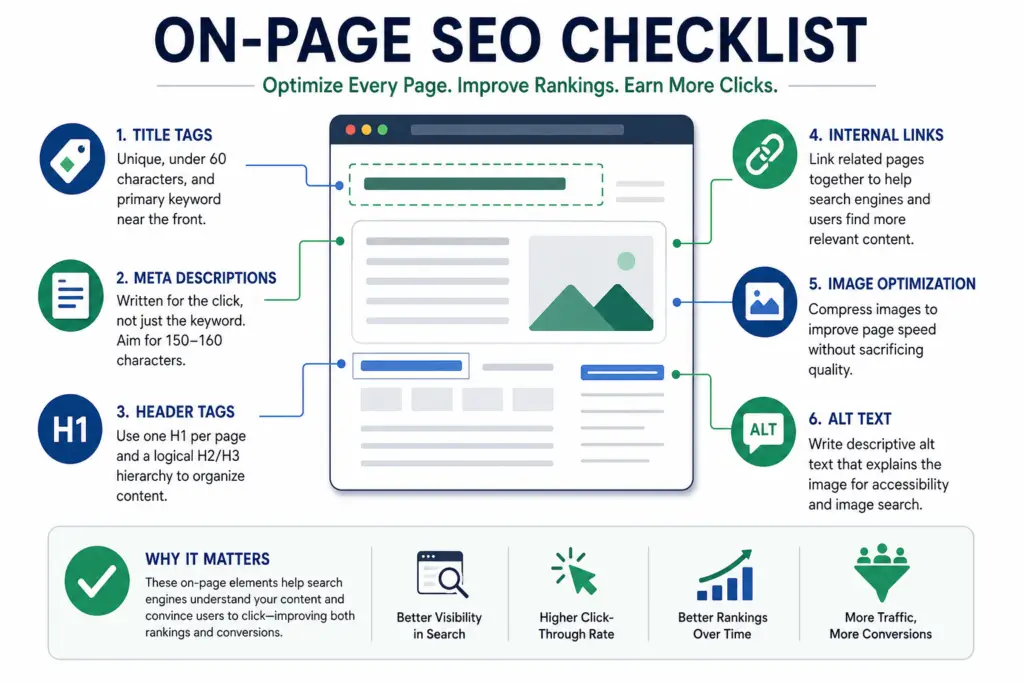
This is where most of your on-page SEO checklist work happens, and it’s what Google evaluates page-by-page:
- Title tags: unique, under 60 characters, primary keyword near the front
- Meta descriptions: written for the click, not just the keyword — 150–160 characters
- Header tags: one H1 per page, logical H2/H3 hierarchy
- Internal links: connect related pages so relevance and authority flow between them
- Image optimization: compress files, use descriptive filenames
- Alt text: describe the image for accessibility and for image search
Skipping one of these rarely sinks a page on its own, but skipping several compounds into a page that never ranks.
4. Improve Technical SEO
Technical SEO for small businesses is often invisible until it’s already costing rankings. Priorities for 2026:
- Page speed: Core Web Vitals still influence rankings and, more directly, conversion rate
- Mobile-friendly design: most local searches happen on a phone
- HTTPS security: table stakes for ranking above a temporary spot
- Fixed broken links: a 404 is a dead end for users and crawlers alike
- XML sitemap: submitted through Google Search Central so new pages get discovered
- Schema markup: structured data that tells Google what your business is, and that Google Business Profile and rich results depend on
A slow, unsecured, or broken site undercuts every other tactic on this list, no matter how strong the content is.
Most of these items only need to be fixed once and then monitored. A monthly crawl of your site — using Google Search Central’s tools or a third-party crawler — will surface new broken links, slow-loading pages, or missing schema before they quietly cost you rankings.
5. Strengthen Local SEO
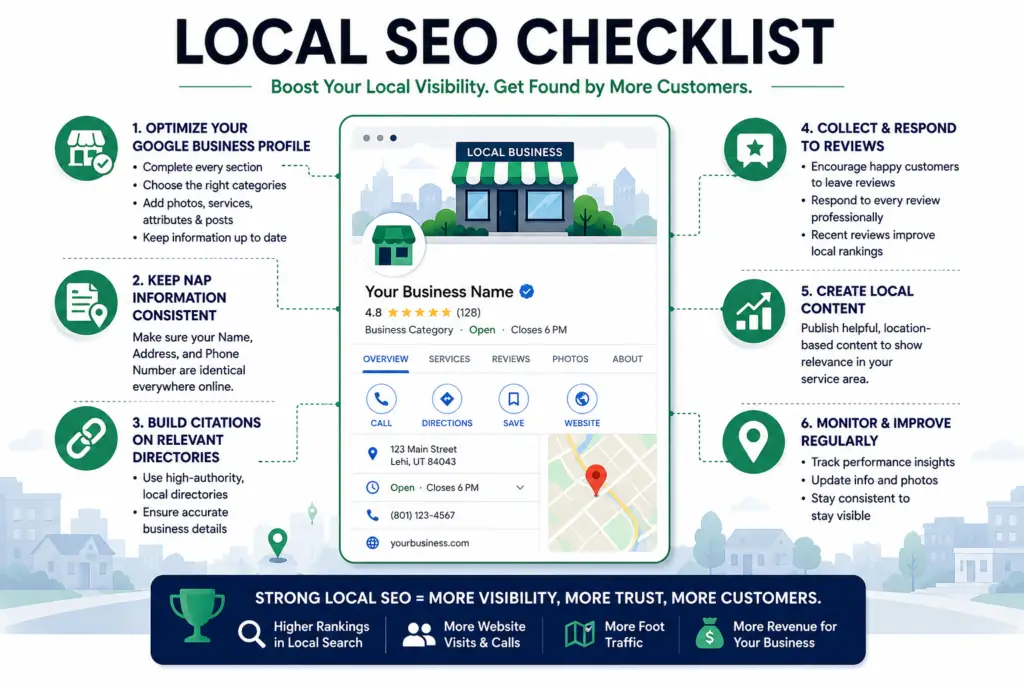
For a local business, this is usually the highest-leverage section on the entire checklist. Local SEO best practices for 2026 come down to four fundamentals:
- Optimize your Google Business Profile completely — categories, services, hours, photos, and posts
- Keep NAP (name, address, phone) information identical across your website, GBP, and every directory
- Build citations on relevant, high-authority local directories
- Actively collect and respond to customer reviews — volume and recency both factor into local rank
For a deeper breakdown of GBP-specific tactics, see our guide to the 7 Best AI Tools for Google Business Profile Optimization in 2026 and our post on AI Business Listing Optimization: Best Practices for 2026. For review management specifically, AI Review Response Tools: How Small Businesses Can Automate Reputation Management covers automating what’s often the most neglected part of a local SEO checklist. If you’re specifically targeting Utah customers, our Local SEO for Utah Businesses guide walks through the same fundamentals with region-specific detail.
6. Publish Helpful Content
Google rewards pages that answer the question a searcher actually had — not the version of the question you assumed they’d ask. Build content around real customer questions, publish consistently rather than in bursts, and update older posts as information changes. Group related posts into topical clusters so both search engines and readers can see how they connect; our Local SEO Automation Tools post is one example of a supporting piece built to reinforce a broader cluster rather than stand alone.
7. Build Authority
Backlinks remain one of the strongest ranking signals, but quality outweighs quantity — one link from a relevant, authoritative local source outperforms a dozen from low-quality directories. Partner with complementary local businesses for co-marketing and cross-linking, and pursue directories that are actually trusted in your industry or region rather than every directory that accepts a submission.
8. Measure Performance
None of the above matters if you can’t tell what’s working. Track:
- Google Search Console: indexing status, query-level clicks and impressions
- Google Analytics: traffic sources and on-site behavior
- Keyword rankings: movement over time, not a single snapshot
- Organic traffic: the trend line, not month-to-month noise
- Conversion tracking: calls, form fills, and direction requests — the actions tied to revenue
9. Common SEO Mistakes
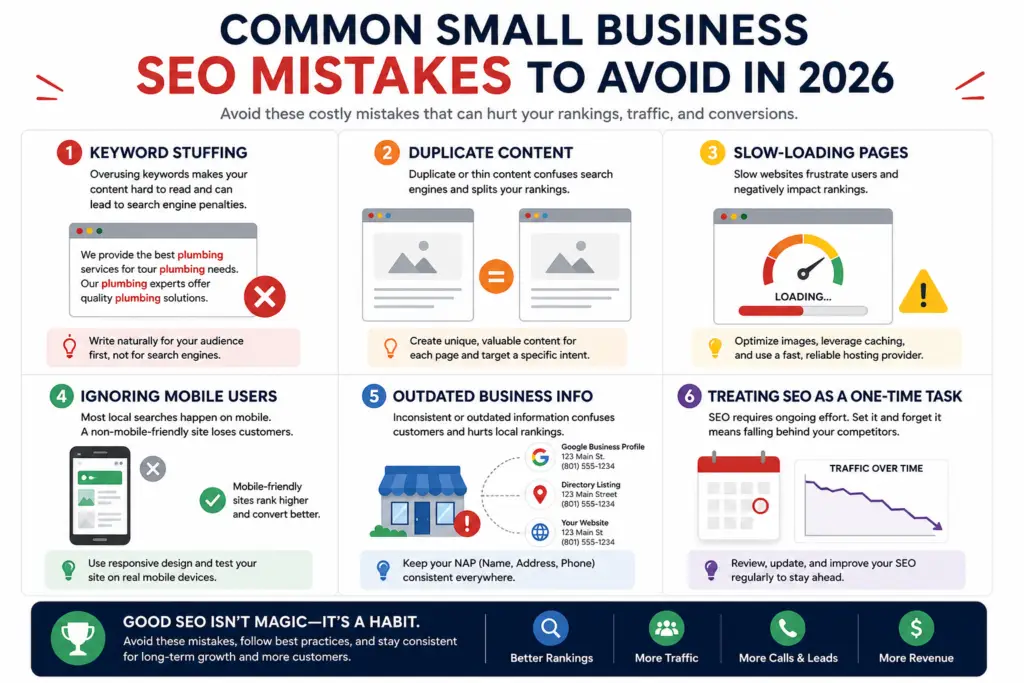
Even businesses following most of this checklist lose ground to a handful of recurring mistakes: keyword stuffing that reads unnaturally and can trigger penalties, duplicate content across location or service pages, slow-loading pages that lose visitors before the content even renders, ignoring mobile users despite mobile now driving most local search traffic, and outdated business information left unchanged on Google Business Profile or the website months after it’s changed.
Most of these mistakes share a root cause: treating SEO as a one-time setup instead of an ongoing habit. A page published correctly two years ago can still be quietly losing ground if pricing, hours, or service areas have changed since and nobody went back to update it.
Quick-Reference Checklist
☐ Research long-tail keywords tied to real customer intent
☐ Write unique title tags and meta descriptions for every page
☐ Structure headers with one H1 and a logical H2/H3 hierarchy
☐ Add internal links between related pages
☐ Compress images and write descriptive alt text
☐ Improve page speed and Core Web Vitals
☐ Confirm mobile-friendly design and HTTPS
☐ Fix broken links and submit an updated XML sitemap
☐ Add schema markup
☐ Fully optimize your Google Business Profile
☐ Keep NAP information consistent everywhere it appears
☐ Build citations on relevant local directories
☐ Collect and respond to customer reviews
☐ Publish and update helpful content regularly
☐ Earn backlinks from relevant, authoritative sources
☐ Monitor Search Console, Analytics, rankings, and conversions
Final Word
Working through this checklist once won’t finish the job — SEO is a maintenance discipline, not a one-time project. If you’d rather have a team execute it than squeeze it in between running your business, our Our Services page covers how SCALAR handles SEO, paid advertising, and website design under one strategy.