
SCALAR Advertising | 8 min read | Strategy & Growth
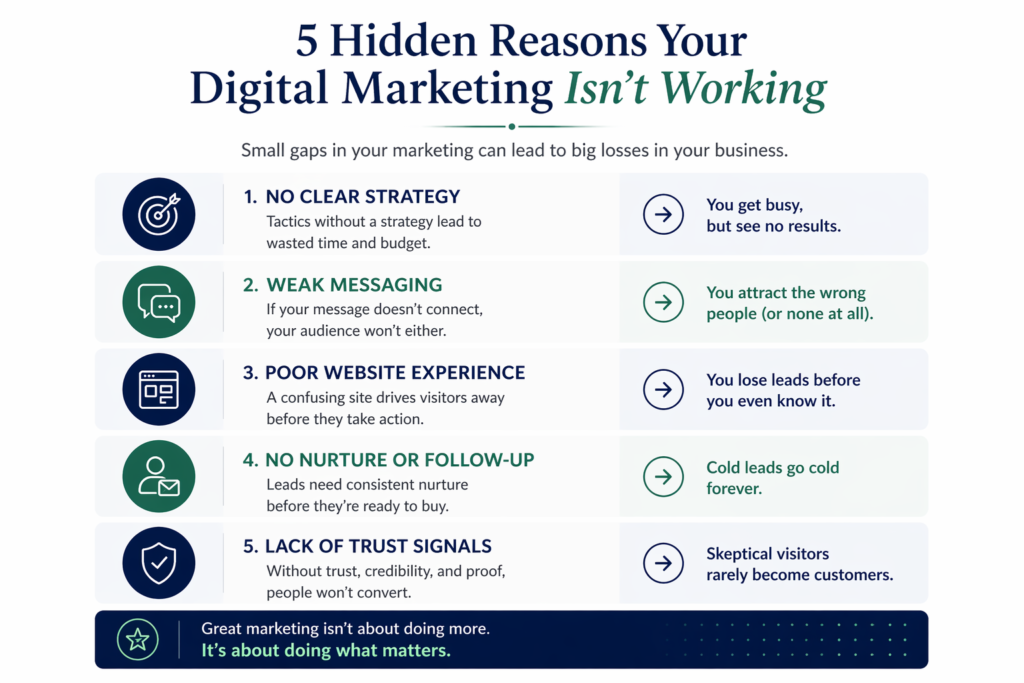
You’ve spent money on ads. You’ve built a website. You might have even hired someone. And yet the leads aren’t coming. The phone isn’t ringing. The revenue isn’t moving. Why is your digital marketing failing?
Here’s what most agencies won’t tell you: the problem is almost never the platform you’re on. It’s not that Facebook ads are dead, or that SEO takes too long, or that your industry “just doesn’t work online.”
The real problem is your system, or more accurately, the absence of one. And until you fix that, no amount of ad spend will save you.
Need help with your website? Check out this article for more key insights. The Simple Website Formula That Turns Visitors Into Customers
The Biggest Myth in Marketing
Most small business owners come to marketing with a reasonable assumption: more traffic means more customers. So they run ads to drive traffic. They chase social media followers. They post content, hoping visibility will eventually translate to revenue.
It almost never does, not by itself. his is one of the core reasons why digital marketing isn’t working for so many otherwise great businesses.
The Myth
“If I can just get more people to see my business, customers will follow.”
The Reality
Traffic without a conversion system is just expensive noise. Clicks don’t pay bills. Customers do.
The data backs this up. Most business websites convert below 3% of their visitors — meaning 97 out of every 100 people who land on your site leave without taking any action. If your traffic doubles but your conversion rate stays flat, you’ve just doubled your ad spend for the same result.
- <3% Average website conversion rate for small businesses
- 70% Of small businesses see no meaningful ROI from their marketing
- 4× Higher ROI for businesses with structured marketing funnels
The Ultimate Digital Marketing Strategy for Small Businesses: 5 Steps to More Leads and Growth→
Where Most Marketing Goes Wrong
There’s a pattern we see constantly. A business owner decides they need marketing. They hear about SEO, so they pay someone to write some blogs try Facebook ads. Then Instagram. Then Google. Each tactic gets a few weeks, doesn’t produce obvious results, gets dropped and the cycle repeats.
This is the random tactics trap. And it’s the single most common reason why digital marketing isn’t working for businesses that are doing everything right.
The root cause is almost always the same: tactics without strategy. There’s no defined audience. No clear message. No deliberate path from “stranger on the internet” to “paying customer.” The business is marketing, but it doesn’t have a marketing system.
“Tactics without strategy is like driving fast with no destination. You’re moving, you’re spending fuel but you’re not getting anywhere useful.”
The businesses that consistently win at marketing aren’t the ones with the biggest budgets. They’re the ones who’ve built a clear, repeatable system that turns attention into action.
The Broken Funnel Problem
Even when businesses do have some structure in place, there’s usually a breakdown somewhere in the funnel and this is often why digital marketing isn’t working even for businesses that feel like they’re “doing everything right.”
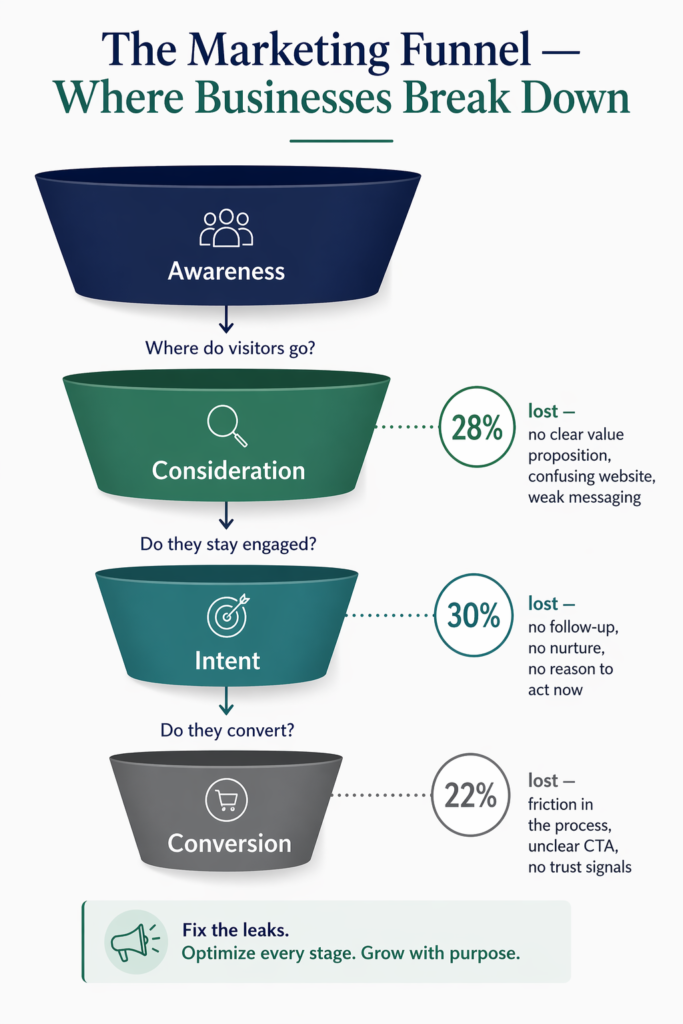
The message here is simple: most businesses are bleeding leads at every stage of the funnel, not just at the top. Pouring more traffic into a broken funnel is like filling a bucket with holes in the bottom. More water, same result.
Messaging vs. Marketing Channels
Here’s a hard truth that most agencies avoid because it means admitting their platform expertise isn’t the thing that matters most: the channel you’re on matters far less than what you say when you’re there.
Bad messaging on Google Ads will fail. Bad messaging on a high-traffic website will fail. Bad messaging sent to a warm audience of your ideal customers will still fail. Messaging is the engine. The channel is just the vehicle. When business owners ask why digital marketing isn’t working for them, nine times out of ten the answer lives here, in the messaging, not the medium.
What bad messaging looks like
Most small business marketing sounds exactly like everyone else’s. “We offer quality service.” “We put customers first.” “Family-owned and operated since 1998.” These statements aren’t wrong — they’re just invisible. They give a potential customer no reason to choose you over anyone else.
Power of strong positioning
Strong positioning is specific. It speaks directly to a real problem your audience is experiencing, articulates a clear outcome they want, and connects that outcome to what you uniquely offer. When someone reads it, they should think: “This is exactly for me.”
“The best ad in the world can’t save weak positioning. But strong positioning can make even a modest ad budget punch well above its weight.”
How to Diagnose Your Marketing
Before you spend another dollar or make another change, you need to know where your marketing is actually breaking. Use this checklist as your diagnostic. The goal isn’t to answer “yes” to everything; it’s to find where the real gaps are.
- Are you getting consistent traffic? If not, the problem starts at awareness, your reach strategy needs work before anything else matters.
- Are visitors staying or bouncing? High bounce rates signal a mismatch between what your ad promised and what your site delivers.
- Are visitors converting to leads? If traffic is there but conversions aren’t, your website isn’t doing its job. The issue is your offer, CTA, or trust-building.
- Are leads qualified? Getting inquiries from people who can’t afford you or don’t actually need your service is a targeting and messaging problem, not a volume problem.
- Are leads converting to customers? If the sales process is falling apart after a good lead, the breakdown is in your follow-up, proposal, or nurture sequence.
- Do you know your cost per acquisition? If you can’t answer this, you can’t optimize anything. Marketing without measurement is just spending money and hoping.
Wherever the checklist breaks down, that’s where to focus first. Everything else is a distraction.
Local SEO for Utah Businesses: How to Rank Higher and Get More Customers→
How to Fix Your Marketing Right Now
You don’t need to rebuild everything overnight. You need to address the right problem in the right order. Here’s a straightforward sequence to follow:
Define your audience with surgical precision
Stop marketing to “anyone who might need your product.” Get specific. Who is your best customer? What do they struggle with? What do they want? What have they already tried? The narrower your focus, the stronger every other marketing decision becomes.
Align your messaging to that audience
Rewrite your value proposition around their specific problem and your specific solution. Kill the generic claims. Replace them with language that makes your ideal customer feel like you understand exactly what they’re going through.
Build a conversion-focused website
Your website should have one job: move the right visitor toward taking action. Clear headline. Clear offer. Clear path forward. Remove anything that creates confusion or dilutes the main message.
Layer your traffic channels deliberately
Once your conversion foundation is solid, introduce traffic strategically. Start with the channel most likely to reach your specific audience fastest. Add channels only when you can measure ROI from the ones you’re already running.
Measure everything that impacts
Set up tracking from day one. Know your cost per lead, your conversion rate by channel, and your customer acquisition cost. This data is what transforms marketing from an expense into an investment with a calculable return.
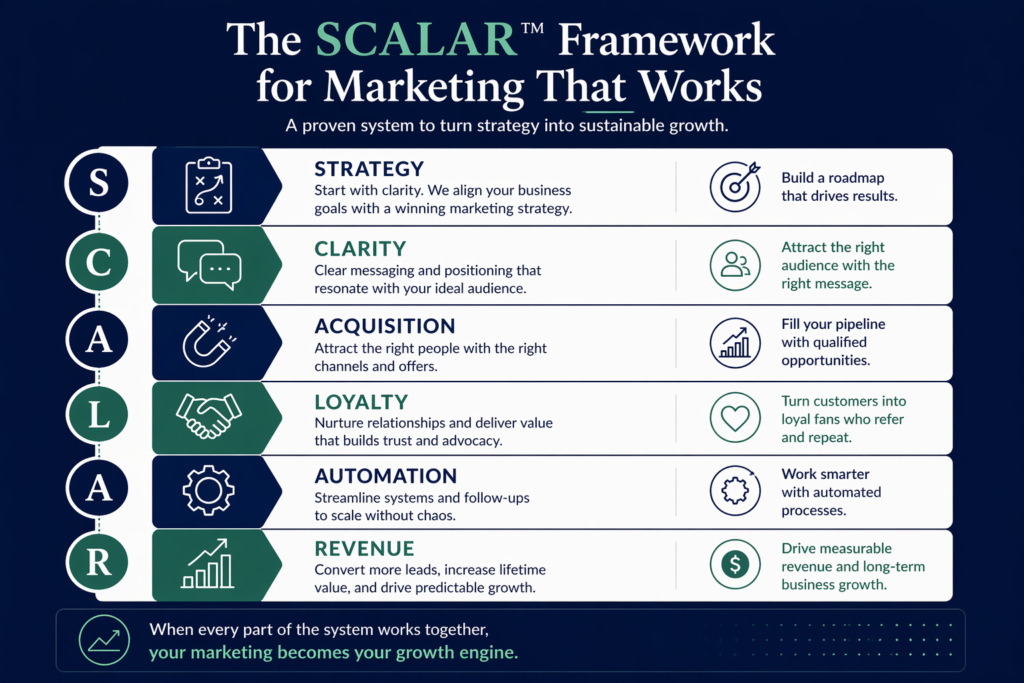
Marketing Is a System. Treat It Like One.
The businesses that consistently generate leads, close customers, and scale their revenue don’t have access to some secret platform or magic formula. They’ve built a system, one that’s deliberately designed, properly measured, and continuously improved.
Understanding why digital marketing isn’t working for your business is the first and most important step. Most small business marketing fails not because the business owner lacks effort or budget, but because they’re operating without a coherent system to drive results. The fix isn’t spending more. It’s building smarter.
You now know where the gaps are. You know what to look for. The only question is whether you’ll address them with the same seriousness you bring to every other part of your business.
“Stop guessing. Start building a marketing system that actually works. One that turns attention into leads, and leads into revenue, on purpose.”
SCALAR.
Strategy-first digital marketing for growth-focused businesses.